
Water Damage Restoration Sanford FL
When ruptured supply lines or roof penetrations flood your property, immediate structural extraction is essential to halt framing rot. Our certified technicians deploy commercial dehumidifiers and deep-wall moisture meters to stabilize damaged cavities quickly. We document moisture metrics daily to ensure your home reaches healthy equilibrium levels.
If sewage is coming up a drain right now, call (407) 555-0166.
Trusted Water Damage Restoration Experts
Our technicians evaluate water intrusion in residential structures with calibrated moisture meters and thermal imaging cameras.
About 15% of housing units locally (3,941 of 25,495) were built before 1960, the era of galvanized steel supply lines and cast iron drains that fail without warning.
About 7% of housing units locally (1,663 of 25,495) were built in the 1960s, overlapping the years aluminium branch wiring was installed that requires extra caution during structural drying.
Homeowners often describe how clogged air conditioner condensate drain pans overflow into attics, soaking insulation and dripping through ceiling drywall to create mold hazards.
When major inundation strikes, we coordinate with property owners handling rapid flood cleanup across inundated living areas to prevent long-term degradation.
Every site is left tidy, secure, and monitored until wood moisture equivalent levels match regional equilibrium.
Our Step-by-Step Restoration Protocol
Operating with scientific psychrometric standards, our emergency storm damage recovery protocol focuses on rapidly neutralizing structural moisture after severe local squalls and roof impacts.
- Comprehensive Thermal Inspection. We map hidden moisture pockets using deep-probe sensors and thermal diagnostics across wall cavities and subfloors. About 29% of housing units here (7,329 of 25,495) were built in the 1970s and 1980s, overlapping the years polybutylene supply piping was commonly installed and prone to sudden joint ruptures.
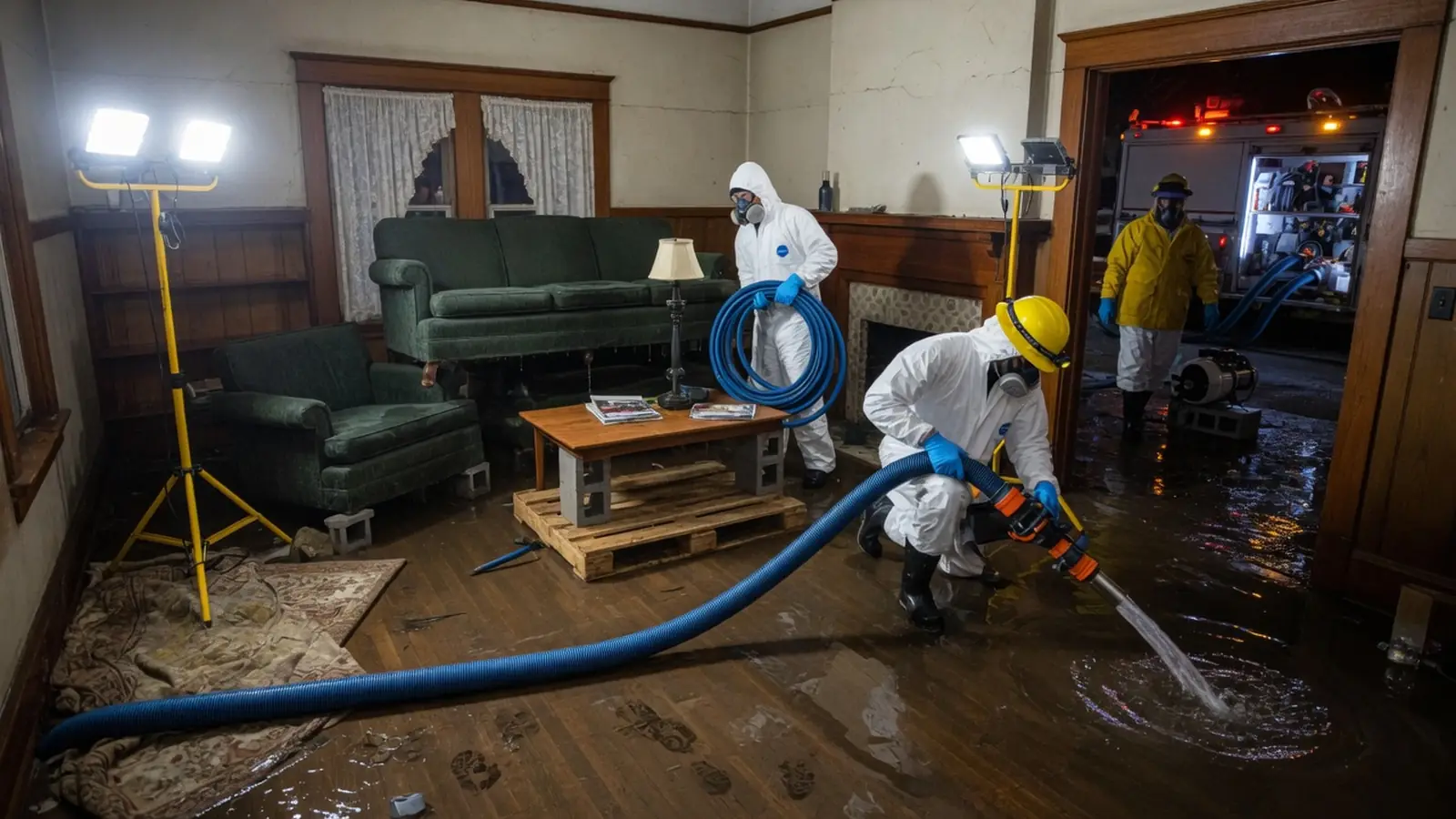
- Water Extraction And Controlled Removal. Standing liquid is pumped out immediately using truck-mounted extraction equipment before unsalvageable porous items are taken down. About 51% of housing units locally (12,933 of 25,495) were built before 1980, the period when asbestos-containing materials and lead paint were still in use, dictating careful environmental protocols during tear-out. A pattern echoed in public discussions is when a burst water pipe in a crawlspace leaves standing water and spreading mold colonies across floor joists, requiring specialized antimicrobials and structural drying.
- Structural Dehumidification And Soil Moisture Control. Industrial low-grain refrigerant dehumidifiers and centrifugal air movers draw ambient humidity out of framing timbers. The dominant mapped soils across the territory (FL117) by acreage are Myakka and EauGallie fine sands; Urban land, 0 to 2 percent slopes; Basinger, Samsula, and Hontoon soils, depressional; Tavares-Millhopper fine sands, 0 to 5 percent slopes. The single most extensive soil unit mapped around the area is Myakka and EauGallie fine sands, covering about 29,547 acres of FL117, where high water tables often drive sub-slab moisture upward after storms.
- Envelope Sealing And Antimicrobial Sanitization. Emergency storm damage recovery prioritizes exterior tarping and board-up to seal the building envelope before commercial dehumidifiers and air movers can safely operate. Wind-driven rain from Central Florida squalls routinely breaches attic soffits and ridge vents in local neighborhoods, saturating blown-in insulation before water spots show on ceilings. We treat exposed rafters and framing with botanical antimicrobials to prevent wood rot.
Our Commitment To Complete Structural Drying
Our iron-clad commitment centers on verifiable moisture readings rather than guesswork, ensuring structural components reach dry standards before equipment is pulled. During intense storms, property owners note that heavy rainfall causes sump pump failures that leave inches of standing water in lower living spaces, requiring commercial extraction and rapid carpet removal. We work methodically alongside certified mold remediation to stop microbial growth across drywall and subflooring without cutting corners or inventing extra charges.
Storm Water Extraction
NOAA radar recorded 3,344 hail signatures within about 15 miles of the center between 2021-2025 (2021: 322, 2022: 783, 2023: 806, 2024: 385, 2025: 1,048). The heaviest recent hail year around the area was 2025, with 1,048 radar hail signatures inside a 15-mile radius that left numerous shingle fractures and hidden attic leaks. We pump standing water and dry structural members before decay starts.
Structural Cavity Drying
Using injected dry airflow systems, we target trapped humidity behind baseboards, vanity toe-kicks, and insulated wall assemblies. This non-destructive drying practice preserves intact drywall whenever microbial thresholds permit. Continuous daily hygrometric tracking verifies framing timbers reach dry standard baseline.
Basement And Crawlspace Remediation
Standing water in low-elevation substructures creates rampant microbial colonization across wood subflooring. We extract contaminated ponding, apply EPA-registered antimicrobial agents, and run high-capacity air scrubbers to purify indoor breathing zones. Vapor barriers are inspected to prevent persistent ground dampness.
Our Commitment To Scientific Structural Recovery
We provide structured moisture mitigation and drying protocols to stabilize properties following plumbing failures and roof intrusions. Every project follows systematic moisture metering and controlled air flow to restore balanced humidity.
- 10Zip Codes Served
- 5Service Areas
- 3Services Offered
Read verified feedback from local property owners who experienced our structured drying protocols, upfront communication, and detailed job-site care firsthand.
“When our baseboards were reinstalled after the flood cuts, the crew matched the mitered joints and wall seams so cleanly you cannot tell where the drywall was opened. The subflooring was leveled flat before new underlayment went down, with zero bounce or squeaks. Their attention to structural alignment saved our original hardwood trim.”
Marcus T.
“The written estimate we received on day one matched our final invoice down to the last dollar without hidden fees or surprise change-orders. The team walked us through line items for equipment runtime and moisture readings before starting any dehumidification. That transparent billing gave us complete confidence during an incredibly stressful week.”
Elena R.
“Every evening before packing up, the crew vacuumed the hallways, stacked power cables neatly along walls, and sealed off the drying zone with clean plastic barriers. We never had to step around loose drywall scraps or muddy boots after they left for the night. That level of daily housekeeping made living through active drying manageable.”
Derek H.
“I received morning text updates with thermal imaging photos showing daily drying progress without having to call or chase down a supervisor. The team clearly explained psychrometric drop numbers and when fans would be removed so I could plan my work schedule. Knowing exactly what was happening each day gave our family tremendous peace of mind.”
Patricia W.